When you hire your first worker, register as an employer with SSS, PhilHealth and Pag-IBIG, and report the worker to SSS and PhilHealth within 30 days of hiring. Pay at least your region's minimum wage; in Metro Manila that is ₱718 a day for retail and service shops with 15 workers or fewer, under Wage Order NCR-28. Deduct the employee's shares, add yours, and remit every month.[1,4,7]
The three registrations
SSS coverage of an employer starts on the first day of operation, and you report each employee within 30 days from hiring. You can register through the Central Business Portal at business.gov.ph or at an SSS branch. See SSS employer registration.[1]
PhilHealth requires all private employers to register, and gives you a PhilHealth Employer Number and a Certificate of Registration. New hires are reported on Form ER2 within 30 days from the day they start. See PhilHealth employer registration.[3,4]
Pag-IBIG coverage is mandatory for employers of employees compulsorily covered by SSS. See Pag-IBIG employer registration.[5]
How much to pay
Wages are set per region. In Metro Manila, under Wage Order NCR-28, effective 26 September 2026, the daily minimum is ₱755 for non-agriculture work and ₱718 for agriculture, retail and service establishments with 15 workers or fewer, and manufacturers regularly employing fewer than 10 workers. Other regions have their own rates. See minimum wage.[7]
A Barangay Micro Business Enterprise registered under RA 9178 is exempt from the Minimum Wage Law, but its employees still get social security and health care benefits. That exemption applies only to a registered BMBE. See BMBE registration.[8]
What comes out of each payslip
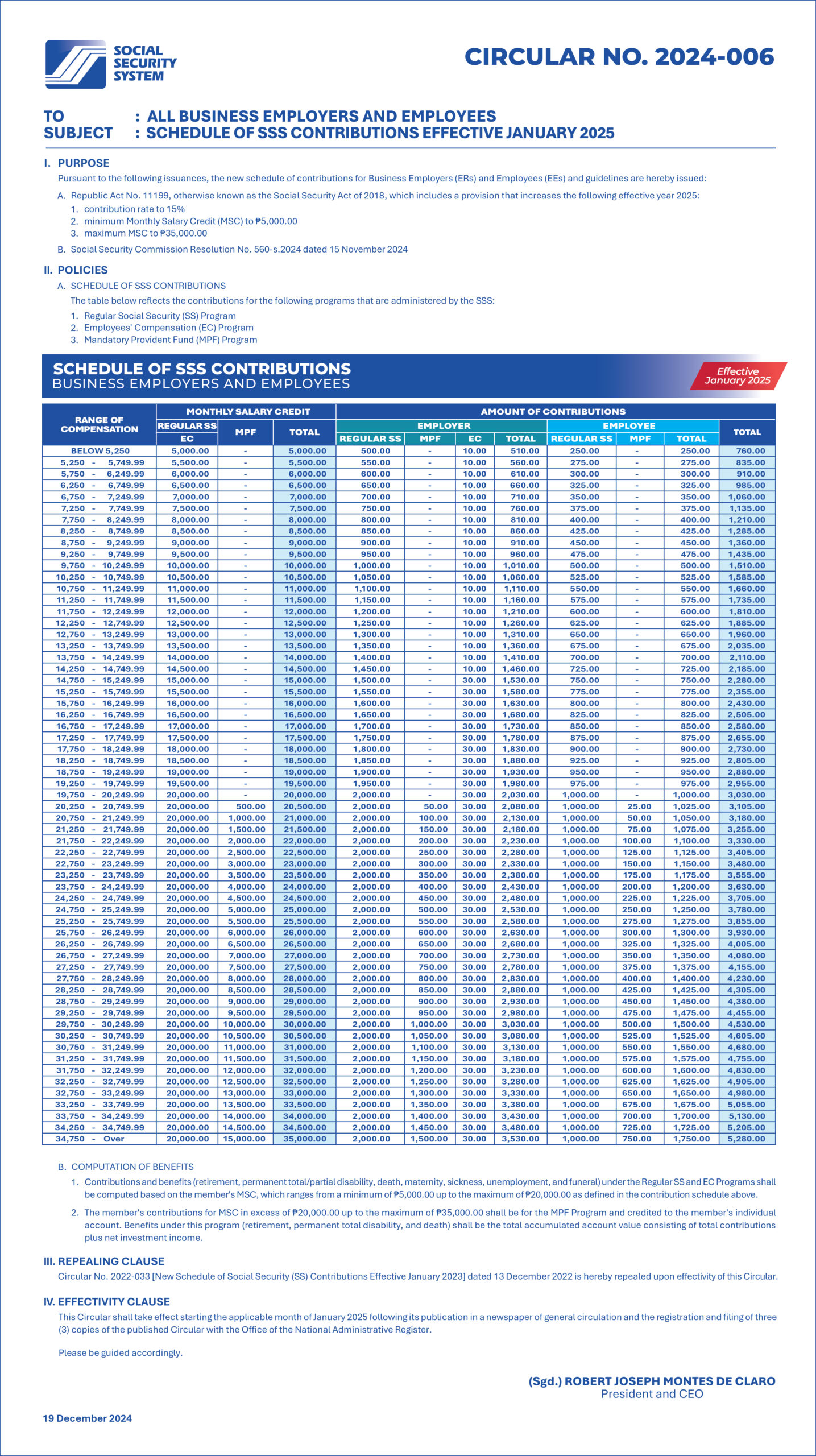
SSS contributions since January 2025 are 15% of the monthly salary credit, which runs from ₱5,000 to ₱35,000. In the lowest bracket (pay below ₱5,250), the employee pays ₱250 and the employer ₱510 including the ₱10 EC.[2]
Pag-IBIG is ₱200 from the employee and ₱200 from the employer for pay of ₱10,000 or more, or 2% each of pay below ₱10,000.[6]
PhilHealth premiums are shared between you and your worker according to PhilHealth's current contribution table. Check that table on PhilHealth's employer pages before your first payroll.
Give each worker a payslip every payday showing the gross pay, each deduction (SSS, PhilHealth, Pag-IBIG) and the net pay. It protects you as much as the worker if there is ever a dispute.
Example: a Metro Manila sari-sari store hires a helper
Example: a sari-sari store in Pasig with one helper falls under the ₱718 daily rate for retail establishments with 15 workers or fewer. If the helper works 26 days in a month, gross pay is at least 26 × ₱718 = ₱18,668. Pag-IBIG is ₱200 from the helper plus ₱200 from the owner, since pay is over ₱10,000. For SSS, the owner looks up the ₱18,668 bracket in the SSS table; it falls between the lowest and top brackets shown here.[7,6,2]
The owner registers with all three agencies before the helper's first day, reports the helper within 30 days, and remits the first month's contributions on time.[1,4]
Other employer duties
Keep a simple employee file for each worker: ID copy, SSS, PhilHealth and Pag-IBIG numbers, start date, rate of pay and signed payslips. DOLE also has establishment reporting rules for employers; see DOLE establishment registration. Ask your city hall whether your mayor's permit needs updating once you have employees.
Monthly contributions at a glance
| Agency | Employee share | Employer share | Basis |
|---|---|---|---|
| SSS (lowest bracket, pay below ₱5,250) | ₱250 | ₱510 incl. ₱10 EC | 15% of salary credit, ₱5,000 to ₱35,000 |
| SSS (top bracket, ₱34,750 and over) | ₱1,750 | ₱3,530 incl. EC | 15% of salary credit |
| Pag-IBIG (pay ₱10,000 or more) | ₱200 | ₱200 | 2% of ₱10,000 Maximum Fund Salary |
| Pag-IBIG (pay below ₱10,000) | 2% of pay | 2% of pay | Actual monthly pay |
Before the first day of work
- Register as an employer with SSS, PhilHealth and Pag-IBIG
- Check your region's minimum wage on the NWPC site
- Collect the worker's SSS, PhilHealth and Pag-IBIG numbers
- Set up a payslip template with every deduction
- Report the worker to SSS and PhilHealth within 30 days
- Put monthly remittance dates on your calendar
Questions people ask
- Do I need SSS, PhilHealth and Pag-IBIG for just one helper?
- Yes. SSS coverage starts on your first day of operation, PhilHealth requires all employers to register, and Pag-IBIG covers employers of SSS-covered employees.
- How soon must I report a new hire?
- Within 30 days of hiring for SSS, and within 30 days from the day the employee starts for PhilHealth (Form ER2).
- Can I pay below minimum wage if my business is small?
- Only a registered BMBE is exempt from the Minimum Wage Law, and its employees keep social security and health benefits. Other small businesses pay at least the regional rate.
- What is the minimum wage in Metro Manila?
- Under Wage Order NCR-28, effective 26 September 2026, ₱755 a day for non-agriculture, and ₱718 for retail and service establishments with 15 workers or fewer.
Outdated advice
Older payroll guides still use ₱100 from each side for Pag-IBIG.
Now: Since February 2024 the Pag-IBIG contribution is ₱200 from the employee and ₱200 from the employer for pay of ₱10,000 or more.[6]
Sources
Checked 13 November 2026. We link the agency's own page for every requirement. Rules change; confirm with the office before you pay.
- Employer (ER) · Social Security System
- Circular No. 2024-006: Schedule of SSS Contributions Effective January 2025 · Social Security System · 19 December 2024
- Employer Registration · PhilHealth
- Reporting Your Employees · PhilHealth
- Business Registration · Pag-IBIG Fund
- Member: Regular Savings (FAQ) · Pag-IBIG Fund
- NCR · National Wages and Productivity Commission · 28 September 2026
- Republic Act No. 9178 · Lawphil (Arellano Law Foundation) · 13 November 2002